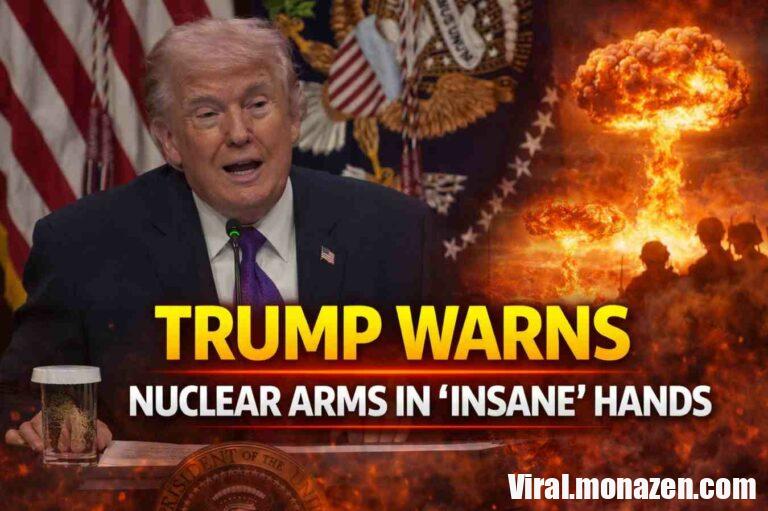
In a moment that quickly sparked international debate, former U.S. President Donald Trump recently issued a warning about what he described as one of the most dangerous realities facing the modern world: the possibility that individuals or regimes acting irrationally could gain access to nuclear weapons.
The comment, delivered during a discussion about global security and strategic deterrence, struck a nerve among policymakers and analysts alike. While the phrase itself was blunt, the concern behind it reflects a longstanding fear shared by nuclear strategists across decades — that the global nuclear balance depends not only on weapons technology and defense systems, but also on the rational behavior of those who control these weapons.
In a world where nine countries possess nuclear arsenals and geopolitical tensions continue to escalate, the warning has reignited questions about the stability of nuclear deterrence and the risks posed by unpredictable leadership.
The Fragile Logic of Nuclear Deterrence
Since the end of World War II, nuclear weapons have operated under a doctrine commonly known as deterrence. The theory is relatively simple: if two adversaries both possess nuclear weapons capable of destroying each other, neither side will initiate a nuclear conflict because doing so would guarantee catastrophic retaliation.
This principle, often referred to as Mutually Assured Destruction (MAD), helped prevent direct conflict between nuclear powers during the Cold War.
However, deterrence assumes that decision-makers act rationally — carefully weighing the consequences before launching weapons that could devastate entire nations.
Trump’s comment highlights the concern that this assumption may not always hold true.
“If someone unstable gains access to nuclear weapons,” one former defense official explained in a recent policy discussion, “the entire logic of deterrence begins to weaken.”
A World With More Nuclear Actors
Today, nuclear weapons are no longer limited to just the United States and Russia. The global nuclear club has expanded to include China, France, the United Kingdom, India, Pakistan, North Korea, and Israel.
Each of these countries operates under different political systems, strategic priorities, and security pressures.
In addition, several countries maintain sophisticated nuclear programs or have the technological capability to develop nuclear weapons relatively quickly if they choose to do so.
The expansion of nuclear capabilities has created a far more complex strategic environment than the bipolar Cold War system that dominated global politics for decades.
Analysts warn that the more actors involved in nuclear deterrence, the greater the risk of miscalculation, misunderstanding, or escalation.
The Fear of Irrational Decision-Making
One of the most unsettling possibilities in nuclear strategy is the emergence of leadership that does not follow traditional deterrence logic.
Strategists sometimes refer to this scenario as the “madman problem” — the fear that a leader might either intentionally or unintentionally make decisions that escalate conflict beyond control.
In such situations, nuclear weapons could become tools of coercion, intimidation, or even impulsive action rather than carefully controlled instruments of strategic balance.
This concern has appeared repeatedly throughout history.
During the Cold War, U.S. and Soviet officials both feared that political instability, internal coups, or miscommunication could lead to nuclear weapons being used without full strategic consideration.
Several close calls — including misinterpreted radar warnings and technical malfunctions — revealed just how fragile the system could be.
Nuclear Weapons and Modern Geopolitics
Trump’s remarks also come at a time when global tensions are once again rising in multiple regions.
Relations between major powers have grown increasingly strained in recent years, with disputes involving:
- U.S.–China strategic competition
- Russia and NATO tensions
- Ongoing nuclear concerns involving North Korea
- Middle Eastern security dynamics
Each of these situations involves complex military calculations and strategic signaling.
In such an environment, nuclear weapons remain the ultimate symbol of both power and vulnerability.
The Risk of Proliferation
Another key concern among security experts is the continued risk of nuclear proliferation — the spread of nuclear weapons technology to additional states or non-state actors.
International agreements such as the Nuclear Non-Proliferation Treaty (NPT) were designed to limit the number of countries possessing nuclear weapons while encouraging disarmament among those that already have them.
However, enforcement of these agreements has often been difficult.
Some countries have pursued nuclear programs despite international pressure, while others have expanded their arsenals to maintain strategic balance.
The result is a global environment in which nuclear technology continues to evolve while political tensions remain unpredictable.
The Human Factor in Nuclear Strategy
Perhaps the most important aspect of Trump’s warning is the reminder that nuclear weapons are ultimately controlled by people.
Missile systems, launch codes, and command structures may be governed by elaborate protocols, but final decisions often rest with a small number of individuals.
This concentration of power has always been a central paradox of nuclear strategy.
The same weapons designed to prevent global war also place extraordinary responsibility in the hands of national leaders.
For this reason, many countries have developed strict command-and-control systems intended to prevent unauthorized or accidental launches.
These systems typically include multiple layers of verification, security checks, and communication protocols designed to ensure that nuclear weapons are used only under the most extreme circumstances.
A Renewed Debate About Nuclear Stability
Trump’s statement has therefore revived an important discussion among policy experts: Is the current nuclear order stable enough to handle the political uncertainties of the 21st century?
Some analysts argue that nuclear deterrence has worked for nearly eight decades and remains the most effective way to prevent large-scale war between major powers.
Others warn that the increasing number of nuclear states, combined with evolving technologies and geopolitical tensions, may be pushing the system toward greater instability.
Emerging technologies such as cyber warfare, artificial intelligence, and hypersonic missiles could further complicate nuclear decision-making by shortening response times and increasing the risk of misinterpretation.
The Global Stakes
Ultimately, the debate surrounding Trump’s comments reflects a broader reality: nuclear weapons remain the most destructive tools ever created by humanity.
Their existence continues to shape international politics, military strategy, and global security.
While many policymakers hope that nuclear deterrence will continue to prevent large-scale conflict, the system depends on a delicate balance of technology, communication, and human judgment.
Even small mistakes could have catastrophic consequences.
As one nuclear policy expert summarized during a recent security conference:
“The greatest danger is not necessarily the weapons themselves. It is the possibility that someone, somewhere, might one day make a decision that no system can stop.”