
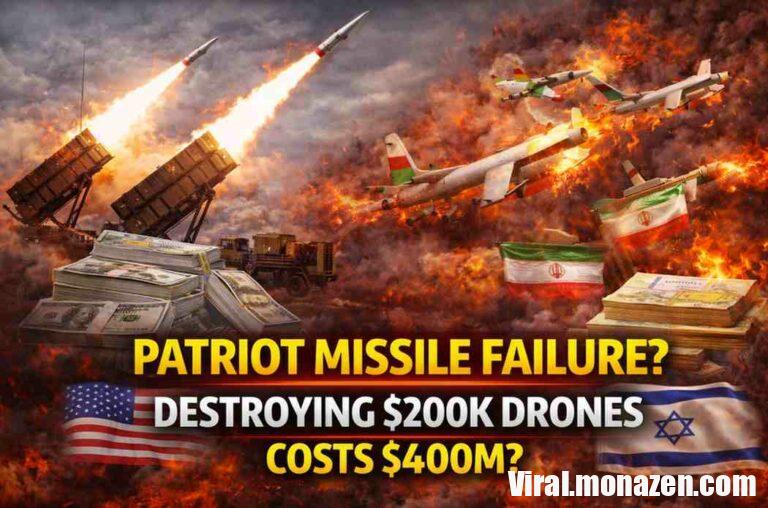
In modern warfare, technological superiority has long been considered the decisive factor on the battlefield. Advanced fighter jets, precision missiles, and sophisticated radar networks have given powerful militaries a clear edge for decades. But recent conflicts and rising tensions in the Middle East are revealing a different kind of strategic reality—one where cost, scalability, and asymmetric tactics may matter just as much as technological sophistication.
At the center of this debate is a simple but unsettling equation that military analysts are increasingly discussing: a low-cost drone worth tens of thousands of dollars can force a defense system to fire interceptor missiles worth several million dollars.
This economic imbalance—sometimes described as the “cost-exchange ratio”—has become a growing concern for defense planners in Washington and other Western capitals. In scenarios involving large numbers of drones, the financial strain of defending against them can quickly escalate, potentially creating a long-term strategic challenge.
The Rise of the Drone Saturation Strategy
Over the past decade, drones have evolved from niche reconnaissance tools into central instruments of modern warfare. Their appeal lies not only in their versatility but also in their relatively low production costs.
Small attack drones can be produced in large numbers using commercially available components. They can be launched from multiple locations, programmed to fly pre-set routes, and coordinated to overwhelm defensive systems.
Military strategists refer to this approach as “saturation attacks.”
Instead of relying on a single high-value weapon, attackers deploy waves of inexpensive drones or rockets simultaneously. The goal is not necessarily to ensure every device reaches its target, but rather to force defenders to expend large quantities of expensive interceptors.
In some cases, a swarm of drones may include both real attack units and decoys designed solely to trigger defensive responses.
This method has already appeared in several conflicts around the world—from Ukraine to the Red Sea—and analysts believe it could become a defining tactic in future wars.
Patriot Missiles and the Cost of Defense
One of the most widely used air defense systems in the world is the Patriot missile system, developed by the United States and deployed by several allied countries.
Patriot batteries are capable of intercepting aircraft, cruise missiles, and certain ballistic missiles. Over the years, upgraded versions—particularly the PAC-3 interceptor—have significantly improved the system’s accuracy and reliability.
However, these capabilities come with a high price tag.
A single Patriot interceptor can cost between $3 million and $4 million, depending on the configuration. When a defensive battery launches multiple interceptors to ensure a successful interception, the cost rises even further.
By contrast, many attack drones can cost less than $20,000 to manufacture.
This enormous cost difference has led some analysts to warn that large-scale drone swarms could create a financial dilemma for even the most advanced militaries.
The 200-to-1 Problem
In military discussions, some experts describe this imbalance as the “200-to-1 ratio.”
In simple terms, a $20,000 drone forcing the launch of a $4 million interceptor creates a cost exchange ratio of roughly 1:200.
While defenders may successfully destroy incoming threats, they may still face the strategic challenge of rapidly depleting their interceptor stockpiles.
Missiles cannot be produced overnight. Manufacturing complex interceptors requires advanced components, specialized facilities, and months of production time.
If a defensive system expends large numbers of interceptors in a short period, replenishing those inventories can become difficult.
The Supply Chain Factor
The issue is not just cost—it is also production capacity.
According to defense industry estimates, global production of advanced interceptor missiles remains limited. Even large defense manufacturers can only produce a certain number of units each year.
In a prolonged conflict involving frequent drone or missile attacks, stockpiles could shrink faster than they can be replaced.
This challenge has already been observed in other theaters of conflict, where the demand for air defense interceptors has surged dramatically.
Defense planners are therefore increasingly concerned about how to sustain defensive operations during long conflicts that involve repeated drone attacks.
The Role of Decoys and Electronic Warfare
Another complication arises from the use of decoys and electronic warfare techniques.
Attackers may deliberately launch drones that are designed to mimic more dangerous threats. These devices may carry minimal payloads—or none at all—but can appear on radar screens as legitimate attack systems.
If defenders cannot quickly distinguish between real threats and decoys, they may still feel compelled to launch interceptor missiles.
This tactic forces defenders to spend valuable resources responding to targets that may not pose significant danger.
In some cases, attackers may also attempt to jam radar systems or exploit gaps in detection coverage to increase the effectiveness of drone swarms.
Strategic Pressure Beyond the Battlefield
The implications of these tactics extend far beyond the battlefield itself.
If defending against large numbers of drones becomes excessively expensive, governments may face growing political pressure at home.
Military operations that require billions of dollars in defensive spending can quickly become controversial, particularly if they continue over long periods without clear strategic progress.
Public opinion, budget constraints, and alliance commitments can all influence how governments respond to these situations.
In this sense, the drone-versus-missile cost imbalance can become not just a military problem but also a political and economic one.
Searching for New Defensive Solutions
Recognizing these challenges, several countries are now exploring alternative ways to defend against drone swarms.
Some of the most promising solutions include:
Directed-Energy Weapons
Laser-based defense systems have attracted growing attention because they can destroy drones at a much lower cost per shot compared with missile interceptors.
Once deployed, laser systems can engage multiple targets without requiring expensive ammunition.
Electronic Warfare Systems
Electronic jamming technology can disrupt the communications and navigation signals that many drones rely on.
If successful, these systems can disable drones without physically destroying them.
Short-Range Interceptors
Some militaries are also developing cheaper interceptor missiles designed specifically for small drones.
These weapons cost far less than traditional air defense interceptors, making them more suitable for high-volume threats.
The Changing Nature of Warfare
The broader lesson emerging from these developments is that modern warfare is becoming increasingly economically complex.
Victory may no longer depend solely on who has the most advanced technology, but also on who can sustain operations at an affordable cost.
Historically, wars have often been decided not just by battlefield tactics but by economic endurance. Nations that can maintain their military resources longer than their opponents tend to gain the strategic advantage.
The growing use of drones and other inexpensive weapons may accelerate this dynamic.
A Strategic Turning Point
As tensions continue to rise in the Middle East and other regions, defense planners around the world are paying close attention to the lessons emerging from these confrontations.
Drone technology is evolving rapidly. Production costs remain relatively low. And the ability to deploy large numbers of unmanned systems may reshape how future conflicts unfold.
At the same time, advanced air defense systems remain essential for protecting cities, military bases, and critical infrastructure.
The challenge for military strategists will be finding ways to balance effectiveness with sustainability.
In the coming years, the contest between inexpensive drones and sophisticated defense systems may become one of the defining features of modern warfare.
And as this technological race continues, the ultimate question may not be which weapon is more powerful—but which strategy proves more sustainable in the long run.