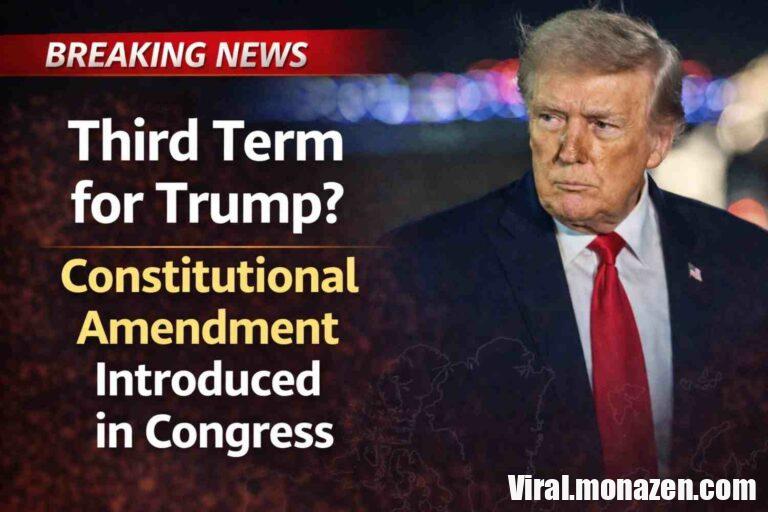
A newly introduced proposal in the U.S. House of Representatives has reignited debate over presidential term limits and the long-standing constitutional rule that prevents American presidents from serving more than two terms in office. The proposal, which would require a constitutional amendment to take effect, has sparked intense discussion among lawmakers, political analysts, and voters about the future of presidential leadership in the United States.
The measure reportedly seeks to explore the possibility of allowing former President Donald Trump to run for a third term. Although the idea faces enormous constitutional and political hurdles, its introduction has revived a broader conversation about the 22nd Amendment, the historical reasons behind presidential term limits, and whether those limits should remain unchanged.
Supporters of the proposal argue that voters should ultimately decide how long a president can serve. Critics, however, warn that altering the two-term limit could fundamentally reshape the American political system and weaken a safeguard that has existed for decades.
The 22nd Amendment and the Two-Term Limit
The U.S. Constitution did not originally limit how many terms a president could serve. For most of the nation’s early history, the tradition of stepping down after two terms was followed voluntarily, largely inspired by the precedent set by George Washington, the country’s first president.
Washington’s decision not to seek a third term in 1796 helped establish a norm that lasted for nearly 150 years.
That tradition was broken in the 20th century when Franklin D. Roosevelt was elected to four terms between 1932 and 1944. Roosevelt’s leadership during the Great Depression and World War II convinced voters to keep him in office longer than any president before or since.
After Roosevelt’s death in 1945, Congress moved to formally limit presidential tenure.
In 1951, the 22nd Amendment was ratified, establishing that no person can be elected president more than twice.
Since then, the two-term limit has remained one of the defining features of American democratic governance.
What the Proposal Would Mean
Any attempt to allow a third presidential term would require changing the Constitution itself.
That process is intentionally difficult.
To amend the Constitution, a proposal must first pass both the House of Representatives and the Senate with a two-thirds majority. After that, it must be ratified by three-quarters of the U.S. states.
Given the deep political divisions currently present in Washington, most analysts believe the likelihood of such an amendment being approved is extremely low.
Still, the proposal has generated headlines and stirred debate among both supporters and critics of former President Trump.
Some proponents say the measure is about restoring greater flexibility in the democratic process.
“If voters want a particular leader to continue serving, they should have the right to choose that,” some supporters argue.
Opponents counter that the term limit exists precisely to prevent any one individual from holding presidential power indefinitely.
Trump’s Political Influence
Donald Trump remains one of the most influential figures in modern American politics.
Even after leaving office, he has maintained a strong presence in national political conversations and continues to command significant support among many Republican voters.
Trump’s supporters often point to his policies on economic growth, border security, and foreign policy as reasons they believe he should continue to have a major role in shaping the country’s future.
Critics, however, argue that the controversy surrounding his presidency demonstrates why strong institutional limits on executive power are necessary.
Regardless of where Americans stand politically, few dispute that Trump has reshaped the Republican Party and the broader political landscape in the United States.
The Debate Over Presidential Term Limits
The proposal to allow a third presidential term has also revived a deeper philosophical debate about term limits themselves.
Supporters of term limits argue that they prevent the concentration of power and encourage political renewal by ensuring new leadership opportunities.
They also note that term limits help preserve the principle that public office is temporary, not permanent.
However, critics of strict limits sometimes argue that they can force experienced leaders out of office even when voters might prefer to keep them.
Some political theorists suggest that elections themselves should be the ultimate form of accountability.
In practice, though, the two-term rule has become deeply embedded in American political culture.
Since its adoption in 1951, no serious effort to overturn the 22nd Amendment has come close to succeeding.
Historical Attempts to Change the Rule
Although rare, proposals to modify presidential term limits have surfaced at different points in American history.
Members of Congress have occasionally introduced amendments suggesting that presidents be allowed to serve additional terms under certain circumstances.
For example, some proposals have suggested allowing three terms instead of two, while others have argued for removing limits altogether.
None of these efforts has advanced far in the legislative process.
Political analysts say that altering the 22nd Amendment would require an extraordinary level of bipartisan agreement, something that is extremely difficult in today’s polarized political environment.
Political Reactions
Reactions to the new proposal have been swift and divided.
Some Republican lawmakers have expressed interest in discussing the issue, framing it as a matter of democratic choice.
Meanwhile, many Democrats and constitutional scholars have strongly opposed the idea, arguing that the two-term limit remains a crucial protection against excessive presidential power.
Legal experts also emphasize that the amendment process is deliberately designed to prevent sudden changes to the Constitution.
By requiring overwhelming support from both Congress and the states, the system ensures that only proposals with broad national consensus can succeed.
What Happens Next
At this stage, the proposal remains only an introduction in the House of Representatives.
Before it could move forward, it would need to gain significant support within congressional committees and among lawmakers from both parties.
Even if it were to pass the House—a scenario many analysts view as unlikely—it would still face the same high hurdle in the Senate.
Then the ratification process would move to the states, where approval from 38 state legislatures would be required.
Given these formidable requirements, political observers believe the proposal is more likely to spark debate than to produce immediate constitutional change.
A Reflection of America’s Political Moment
Regardless of its chances of success, the proposal illustrates the intense political energy surrounding the question of leadership and the future direction of the country.
It also reflects how influential figures like Donald Trump continue to shape conversations about American governance long after leaving office.
For some Americans, the idea represents an opportunity to reconsider long-standing rules.
For others, it serves as a reminder of why constitutional safeguards were created in the first place.
Either way, the debate underscores how deeply questions about power, democracy, and leadership remain at the center of the American political system.
As discussions continue in Washington, the proposal is likely to remain a talking point in broader debates about the Constitution and the evolving nature of U.S. politics.