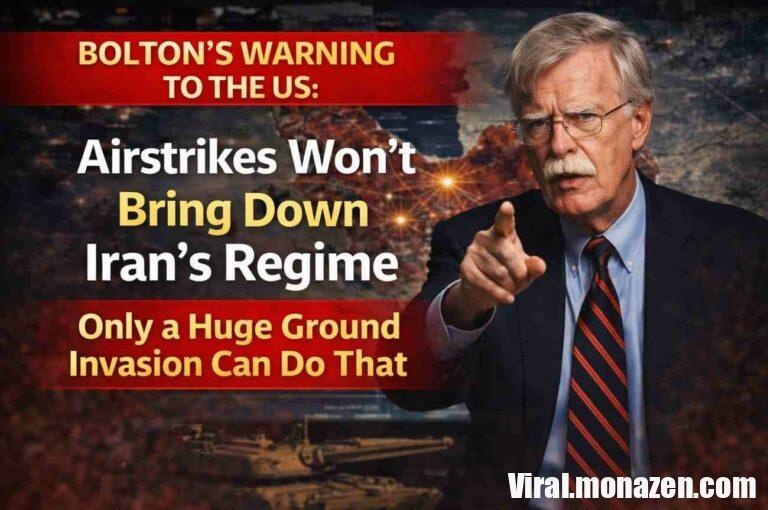
Former U.S. National Security Adviser John Bolton has issued a blunt assessment of the challenges involved in attempting to overthrow Iran’s ruling system, warning that airstrikes, economic pressure, or targeted military actions alone would be unlikely to collapse the Iranian regime.
Speaking in recent commentary on the escalating tensions between Iran and the West, Bolton argued that the Iranian political structure is far more resilient than many observers assume. According to him, any serious attempt to replace the current leadership in Tehran would require far more than limited military operations.
His remarks highlight a critical reality often overlooked in discussions about regime change: Iran is not governed by a single individual whose removal would automatically dismantle the entire system. Instead, Bolton described the country’s political structure as layered and deeply institutionalized.
“The idea that you can simply strike a few military targets and expect the regime to collapse is unrealistic,” Bolton suggested, emphasizing that Iran’s leadership is supported by multiple power centers, including religious institutions, security services, intelligence agencies, and political networks.
A System Built for Survival
Iran’s modern political system emerged from the 1979 Islamic Revolution, which replaced the Western-backed monarchy of Shah Mohammad Reza Pahlavi with a theocratic republic led by Ayatollah Ruhollah Khomeini.
Over the decades since the revolution, the country has developed a complex web of political, military, and ideological institutions designed specifically to protect the ruling structure from both internal dissent and external threats.
At the center of that system sits the Supreme Leader, currently Ayatollah Ali Khamenei, who holds ultimate authority over Iran’s military, judiciary, and key political decisions.
But Bolton argues that the regime’s stability does not depend solely on one figure.
Instead, Iran’s leadership is supported by powerful institutions such as the Islamic Revolutionary Guard Corps (IRGC), a military organization that operates alongside Iran’s conventional armed forces but maintains its own command structure and economic influence.
The IRGC controls significant portions of Iran’s economy and oversees a network of allied groups throughout the Middle East.
These institutional layers, Bolton argues, make the system highly resistant to external pressure.
“Even if you remove one leader or destroy certain facilities, the rest of the system is built to keep functioning,” he explained.
Geography and Population: A Strategic Challenge
Another factor Bolton highlighted is Iran’s sheer size and population, both of which would complicate any large-scale military campaign.
Iran is the second-largest country in the Middle East, covering more than 1.6 million square kilometers—an area roughly three times the size of France.
It is also home to more than 85 million people, making it one of the region’s most populous nations.
Such geographic and demographic realities present significant logistical challenges for any potential military intervention.
Bolton suggested that if the objective were truly to overthrow the Iranian government through force, it would likely require a massive ground operation involving hundreds of thousands of troops.
Some estimates, he said, could reach 600,000 soldiers or more, potentially involving both U.S. forces and NATO allies.
That scale of military commitment would rival some of the largest conflicts of the modern era.
Airstrikes vs. Regime Change
Bolton also emphasized the difference between military strikes and regime change.
Airstrikes can damage infrastructure, disrupt military capabilities, and apply pressure on a government.
But historically, they have rarely succeeded in overthrowing entrenched political systems on their own.
Examples from recent history illustrate this reality.
In Iraq, the removal of Saddam Hussein in 2003 required a full-scale invasion and occupation.
Similarly, in Afghanistan, a prolonged ground presence followed the initial military campaign in 2001.
Even then, the long-term political outcomes proved complex and unpredictable.
Bolton warned that assuming Iran would collapse quickly under air power alone would be a serious miscalculation.
“It’s not a matter of a few strikes changing everything overnight,” he said.
The Strategic Importance of the Strait of Hormuz
One of the most critical concerns raised by Bolton involves the Strait of Hormuz, a narrow waterway connecting the Persian Gulf to the Gulf of Oman and the Arabian Sea.
Roughly one-fifth of the world’s oil supply passes through this strategic corridor.
Iran has long maintained the ability to disrupt shipping in the area, either through naval forces, missile systems, or allied groups.
Bolton warned that if tensions escalated into a wider conflict, Tehran could attempt to close or destabilize the Strait of Hormuz, triggering severe consequences for global energy markets.
Such a move would likely cause oil prices to surge worldwide, impacting transportation costs, supply chains, and national economies.
Even temporary disruptions could send shockwaves through global markets.
That possibility is one reason why policymakers often approach direct conflict with Iran cautiously.
The Cost of a Long War
Bolton’s comments also addressed the broader consequences of prolonged conflict.
He noted that while Iran might endure significant damage from military strikes, the cost of an extended war would not fall on Iran alone.
The United States and its allies would also face substantial financial and strategic burdens.
Military deployments, air defense systems, and logistical operations across the Middle East would require enormous resources.
Additionally, Bolton warned that modern warfare could rapidly strain regional defense systems.
Missile attacks, drone operations, and cyber warfare could spread across multiple countries.
This would transform what might begin as a localized conflict into a much wider regional confrontation.
Lessons From History
Many analysts agree that regime change efforts have historically proven far more difficult than initial military planners expected.
Examples from Iraq, Afghanistan, and Libya demonstrate how quickly complex conflicts can evolve once political systems collapse.
Removing a government is only the first step.
Stabilizing a country afterward can require years—or even decades—of international involvement.
Bolton’s remarks reflect this broader historical lesson.
While he has often advocated strong policies toward Iran, his warning underscores the reality that military pressure alone rarely produces simple outcomes.
A Complex Strategic Debate
The question of how to deal with Iran continues to divide policymakers and analysts.
Some argue that stronger military pressure is necessary to deter Iranian actions across the Middle East.
Others believe diplomacy and economic negotiations remain the most viable path to reducing tensions.
Bolton’s assessment adds another perspective to that ongoing debate.
His core message is that any plan to fundamentally change Iran’s political system would require enormous resources and long-term commitment.
It would not be the quick or simple operation some might imagine.
The Bottom Line
John Bolton’s warning serves as a reminder that geopolitics rarely offers easy solutions.
Iran’s political system, geographic scale, military capabilities, and regional influence make it one of the most complex strategic challenges facing global policymakers.
Military strikes might shift the balance of power temporarily.
But according to Bolton, overthrowing Iran’s leadership through force alone would likely require a far larger effort than most governments are prepared to undertake.
In the end, the debate over Iran’s future—and the world’s response—remains one of the most consequential questions in modern international politics.