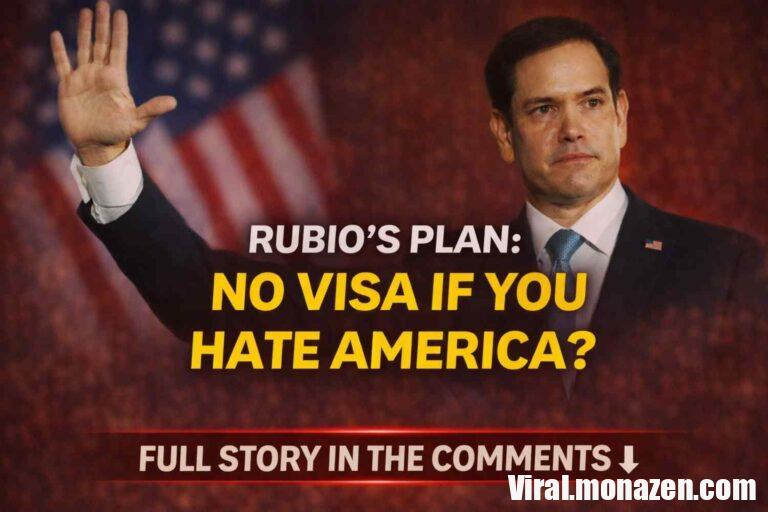
In a political climate already defined by intense debates over immigration and national identity, remarks attributed to Senator Marco Rubio have ignited fresh controversy across the United States. Rubio’s statement — that foreign nationals who “hate America” or support violence against the country should lose their visas — has rapidly circulated online, fueling passionate reactions from both supporters and critics.
The idea resonates strongly with some Americans who argue that entry into the United States is a privilege that carries responsibilities. Others warn that such policies could blur the line between protecting national security and restricting freedom of expression.
As the discussion spreads across political circles, social media platforms, and policy forums, Rubio’s comments have become the latest flashpoint in a broader national conversation about immigration, loyalty, and the limits of free speech.
The Statement That Triggered the Debate
According to remarks shared widely online, Rubio framed the issue in stark terms:
If someone comes to the United States and openly expresses hatred for the country, encourages violence against Americans, or supports designated terrorist groups, he argued, that individual should not expect to retain the privilege of staying in the country.
In simplified terms, the position can be summarized in three points often repeated in viral posts:
- Hate America openly → visa revoked
- Incite violence against Americans → deportation
- Support terrorist organizations → immediate removal
For Rubio and his supporters, the principle is straightforward: immigration privileges should be tied to respect for the country’s laws and values.
But for critics, the question is far more complicated.
Immigration Privilege vs. Constitutional Rights
At the center of the debate lies a key legal and philosophical question: how far can the government go in regulating the behavior and speech of non-citizens living in the United States?
Immigration law in the U.S. already allows authorities to deny visas or deport individuals for a range of reasons related to national security. Support for terrorist organizations, for instance, has long been grounds for removal under federal law.
However, the concept of punishing someone simply for expressing dislike or criticism of the United States raises constitutional concerns.
Legal scholars note that the First Amendment protects free speech broadly, though its protections apply differently depending on immigration status.
While non-citizens do enjoy many constitutional protections, courts have historically allowed the government greater authority over immigration matters than over the rights of citizens.
Still, the idea of linking visa status to subjective judgments about “hate toward America” raises concerns about how such a standard would be defined — and enforced.
A Long History of Loyalty Debates
The argument that immigrants should demonstrate loyalty to their host country is not new.
Throughout American history, periods of political tension have often produced debates about allegiance and national identity.
During World War I and World War II, for example, government policies scrutinized immigrants and foreign nationals for signs of disloyalty. In the Cold War era, fears about communist influence led to investigations into political beliefs and associations.
In more recent decades, the focus has shifted toward terrorism and extremism.
Following the attacks of September 11, 2001, immigration laws were tightened dramatically to prevent individuals connected to extremist groups from entering or remaining in the country.
Rubio’s remarks appear to build on that post-9/11 framework, but extend it into a broader cultural and political context.
Supporters Applaud a Tough Approach
Many conservatives and immigration-restriction advocates strongly support Rubio’s position.
For them, the argument is simple: the United States should not be obligated to host individuals who openly despise the country or advocate harm against it.
Supporters often frame the issue as one of fairness and gratitude.
They argue that millions of immigrants come to the United States seeking opportunity, safety, and economic advancement. Those who take advantage of those opportunities while simultaneously attacking the country’s values, they say, undermine the system that allowed them to enter in the first place.
Some also view the policy as a national security measure, suggesting that early action against individuals promoting extremist rhetoric could prevent more serious threats.
For these supporters, Rubio’s message is less about suppressing speech and more about protecting the nation.
Critics Warn of Slippery Slopes
Opponents of the proposal see it very differently.
Civil liberties advocates argue that defining “hate toward America” could easily become politically weaponized.
Criticism of government policies — whether about foreign policy, policing, or social issues — could potentially be interpreted as anti-American sentiment depending on who holds power.
Legal experts caution that any policy tying immigration status to political speech could raise serious constitutional challenges.
Others worry that such rules could create a climate of fear among international students, workers, and other visa holders who may feel reluctant to express opinions about U.S. policies.
Universities, in particular, have raised concerns that restrictions on speech could undermine academic freedom and open debate.
The Global Dimension
The debate also has implications beyond American borders.
The United States has long promoted itself as a nation built on free expression and democratic values. Policies perceived as limiting speech could affect how the country is viewed internationally.
Foreign governments and human rights organizations often watch U.S. immigration policy closely, especially when it intersects with issues of civil liberties.
At the same time, other countries maintain strict rules about the behavior of non-citizens within their borders, particularly when national security is involved.
Supporters of Rubio’s position argue that the United States should not be expected to apply weaker standards than other nations.
Political Context
Rubio’s remarks come at a time when immigration policy is once again a central issue in American politics.
Debates about border security, asylum policies, and the treatment of migrants have intensified ahead of upcoming elections.
In this environment, strong rhetoric about immigration and national loyalty resonates with many voters who view border control and national identity as critical priorities.
For politicians, statements like Rubio’s can serve both as policy proposals and as signals to supporters about broader ideological commitments.
Whether such ideas eventually become law, however, depends on the legislative process — and on how courts interpret any resulting policies.
The Role of Social Media
Much of the attention surrounding Rubio’s comments has been amplified by social media platforms.
Posts featuring dramatic headlines and bold graphics have spread widely online, often framing the issue in stark terms that encourage strong reactions.
While these posts can bring attention to important policy debates, they can also oversimplify complex legal questions.
Immigration law, constitutional rights, and national security policies involve layers of nuance that rarely fit neatly into viral headlines.
Nevertheless, the speed at which such messages spread online demonstrates how quickly political discussions can shape public opinion.
What Happens Next?
For now, Rubio’s remarks remain part of a broader political debate rather than a specific legislative proposal.
Whether similar ideas appear in future immigration bills remains to be seen.
If such policies were introduced, they would almost certainly face scrutiny in Congress and in federal courts.
The outcome would likely hinge on how lawmakers and judges balance national security concerns with constitutional protections for speech and political expression.
A Larger Question About American Identity
Beyond the immediate policy discussion, the controversy touches on a deeper question about what it means to be part of American society.
The United States has long defined itself both as a nation of laws and as a nation built on freedom of expression.
Balancing those principles has never been simple.
Some Americans believe that welcoming immigrants should come with clear expectations of loyalty and respect for the country.
Others argue that the ability to criticize the nation — even harshly — is itself a core American value.
Rubio’s remarks have brought those competing visions into sharp focus.
And as the debate continues, they highlight a fundamental tension at the heart of American democracy: how to protect the nation while preserving the freedoms that define it.