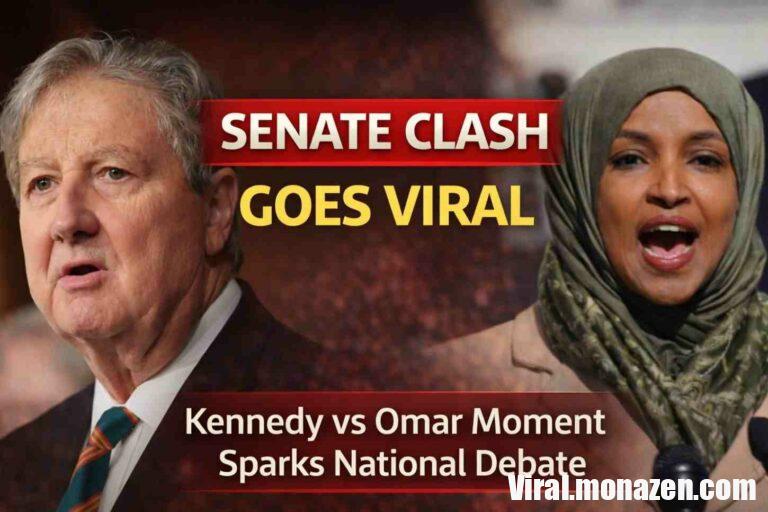
In an era where political moments can travel around the world in seconds, the line between legislative debate and viral spectacle has become increasingly thin. Recently, a dramatic account circulating online about a confrontation involving U.S. Senator John Neely Kennedy and Representative Ilhan Omar has ignited intense discussion across social media and political forums.
Supporters describe the moment as a blunt expression of frustration with progressive politics. Critics view it as another example of inflammatory rhetoric that deepens the nation’s already sharp political divisions. Regardless of interpretation, the story illustrates how powerful language, partisan narratives, and viral storytelling now shape the public’s perception of political events in Washington.
The Rise of Viral Political Moments
Modern political communication rarely stays confined to congressional chambers or televised hearings. A statement delivered in a committee room can quickly become a viral clip, meme, or headline that spreads across platforms such as X, Facebook, and YouTube.
In this case, a dramatic retelling of an alleged Senate confrontation began circulating online, portraying Senator Kennedy delivering a scathing rebuke to progressive lawmakers. The narrative, written in vivid language and shared widely across political communities, described stunned reactions inside the chamber and an explosive response from audiences watching online.
However, as with many viral political stories, the exact details of the moment are difficult to verify. Viral narratives often combine real political tensions with dramatic storytelling that exaggerates the scale or context of events.
What matters more than the literal accuracy of each line is the emotional response the story generates. Supporters and critics alike react not just to the words themselves, but to the broader political themes they represent.
Senator John Kennedy’s Political Style
Senator John Neely Kennedy, a Republican from Louisiana, is well known for his distinctive speaking style. His remarks often feature colorful metaphors, humor, and plainspoken language rooted in his southern background.
Kennedy’s communication strategy reflects a broader trend among modern politicians who aim to speak in memorable sound bites that resonate beyond traditional news coverage. In a crowded media landscape, the ability to deliver a line that captures public attention can be politically valuable.
Supporters see Kennedy’s approach as refreshingly direct. They argue that his language cuts through what they view as overly cautious political speech and speaks plainly about issues they believe matter to everyday Americans.
Critics, however, argue that such rhetoric can oversimplify complex issues and contribute to a confrontational political environment where compromise becomes more difficult.
Ilhan Omar and the National Debate Over Policy
Representative Ilhan Omar, a Democrat from Minnesota, has also become a central figure in national political debates. As one of the first Muslim women elected to Congress and a refugee who came to the United States as a child, her personal story has drawn significant attention.
Omar is a vocal advocate for progressive policies on issues such as immigration, foreign policy, and social justice. Her outspoken positions have earned strong support from progressive activists but have also made her a frequent target of criticism from conservative commentators.
The clash between Omar and conservative politicians often reflects deeper disagreements about the direction of American policy and identity. Debates about immigration, national security, and social values frequently become symbolic battlegrounds where political leaders represent broader ideological movements.
Political Rhetoric in a Polarized Era
The United States has long experienced sharp political debates, but many analysts believe the tone of those debates has intensified in recent years. Political figures from both parties increasingly frame disagreements in moral or existential terms rather than as policy disputes.
This environment encourages dramatic language and confrontational exchanges that capture public attention. While such rhetoric energizes political bases, it can also deepen divisions between opposing camps.
Experts in political communication note that viral storytelling often amplifies these dynamics. When a moment is framed as a dramatic showdown between opposing ideologies, it becomes easier for audiences to view politics as a conflict between heroes and villains rather than a negotiation between competing interests.
The Role of Social Media Amplification
The speed with which political narratives spread online has transformed how Americans consume news. A single clip or quote can reach millions of viewers before traditional journalists have time to verify its context.
This rapid amplification can create powerful impressions even when the original event was less dramatic than the viral story suggests. Emotional storytelling—especially when combined with strong political identity—often travels farther and faster than careful analysis.
Political strategists increasingly understand this dynamic. A memorable statement can generate enormous attention, shaping public perception and influencing the broader media conversation.
Public Reaction and Political Identity
The viral story about Senator Kennedy’s remarks quickly sparked passionate reactions across the political spectrum. Supporters celebrated the alleged moment as a forceful defense of patriotism and national values. Many shared the story alongside messages praising Kennedy’s willingness to confront political opponents directly.
Critics responded just as strongly, arguing that rhetoric suggesting political opponents should leave the country crosses a dangerous line in democratic discourse. They emphasized that political disagreement is a fundamental part of American democracy and should not be framed as disloyalty.
The divide in reactions highlights how political identity often shapes interpretation. People tend to view the same moment very differently depending on their broader political beliefs.
The Broader Context of Congressional Debate
Inside Congress, heated exchanges are not uncommon. Lawmakers regularly challenge one another’s arguments during committee hearings, floor debates, and media interviews.
Yet the internal dynamics of congressional debate often differ from how those moments appear online. Many lawmakers who clash publicly also collaborate behind the scenes on legislation affecting their states or districts.
Political theater has long been part of American democracy, but the digital age has magnified its impact. Moments that might once have been brief exchanges within the chamber can now become national talking points.
The Challenge of Navigating Political Information
For voters and observers, the rapid spread of political narratives presents both opportunities and challenges. On one hand, digital media allows citizens to witness political debates directly rather than relying solely on filtered summaries.
On the other hand, viral stories can blur the line between fact, interpretation, and dramatization. Distinguishing between verified events and emotionally compelling narratives requires careful attention to credible sources and context.
Political scientists emphasize the importance of critical media literacy in this environment. Understanding how information spreads—and why certain stories gain traction—helps citizens engage with politics more thoughtfully.
A Moment Reflecting the Nation’s Divisions
Whether interpreted as a dramatic confrontation or simply another example of partisan rhetoric, the viral story surrounding Senator Kennedy and Representative Omar reflects a broader truth about modern American politics: the national conversation is increasingly shaped by moments designed to capture attention.
The story’s rapid spread shows how powerful narratives can be in a political climate defined by sharp ideological divides. It also demonstrates how quickly a single moment—real or embellished—can become a symbol for larger debates about patriotism, identity, and the direction of the country.
Looking Ahead
As technology continues to reshape the media landscape, viral political moments will likely remain a central feature of public discourse. Politicians, journalists, and voters alike are adapting to a world where every speech, interview, or confrontation can instantly reach a global audience.
For the American political system, the challenge is balancing passionate debate with the democratic principles that allow competing ideas to coexist. Strong disagreements are inevitable in a diverse society, but the tone and substance of those disagreements will continue to shape the country’s political future.
The viral story of a fiery Senate confrontation may fade from headlines in time. Yet the forces that propelled it into the national spotlight—partisan identity, dramatic storytelling, and the power of digital media—are likely to remain defining features of American politics for years to come.