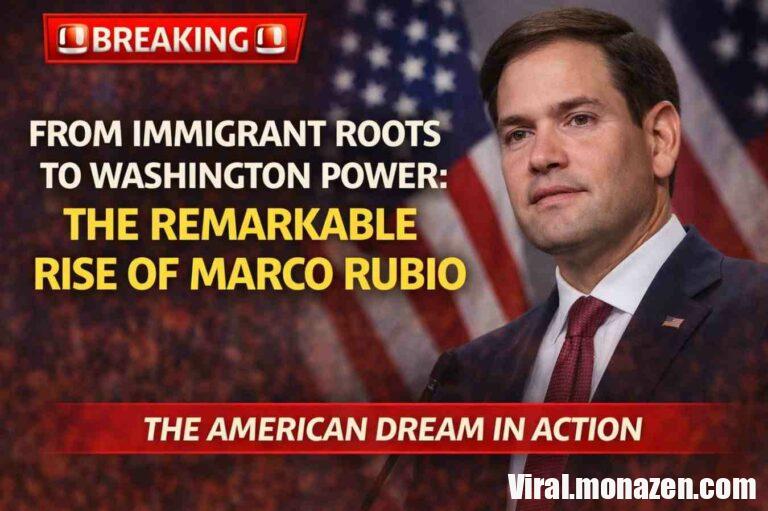
Few stories in modern American politics capture the idea of upward mobility and opportunity quite like that of Marco Rubio. Born to immigrant parents who arrived in the United States seeking freedom and economic opportunity, Rubio’s life journey reflects a narrative often associated with the American Dream: a path from modest beginnings to the highest levels of government and international diplomacy.
Over the years, Rubio’s biography has become a powerful part of his political identity. Supporters frequently highlight his family’s experience leaving Cuba, their struggles to build a new life in the United States, and his rise through education and politics to become a U.S. senator and one of the country’s most prominent foreign policy voices.
While political opinions about Rubio’s policies vary widely, his life story remains one of the most recognizable examples of how immigrant families have shaped American political leadership.
A Family Seeking Opportunity
Marco Rubio was born in Miami, Florida, in 1971 to parents who had emigrated from Cuba.
Like many immigrants arriving in the United States during the mid-20th century, Rubio’s parents came in search of stability, opportunity, and a future free from political turmoil.
Rubio’s father worked as a bartender, while his mother held jobs including work as a hotel maid and cashier. Their jobs were modest, but they represented the determination common among many immigrant families striving to build a better life for their children.
Rubio has often spoken publicly about those early years, describing a childhood shaped by hard work, family values, and a belief in education as the key to opportunity.
For his parents, the goal was clear: provide their children with opportunities they themselves never had.
The First in the Family to Attend College
One of the defining milestones in Rubio’s life came when he became the first member of his family to attend college.
Higher education has long been considered a gateway to upward mobility in the United States, particularly for families who arrive with limited financial resources.
Rubio attended the University of Florida, where he earned a bachelor’s degree in political science. He later went on to receive a law degree from the University of Miami School of Law.
These educational experiences not only opened professional doors but also shaped Rubio’s interest in public service and government.
Like many young Americans drawn to politics, Rubio saw public leadership as a way to influence policy and improve opportunities for others.
Early Steps in Politics
Rubio’s political career began at the local level.
In the late 1990s, he was elected to the West Miami City Commission, gaining experience in local governance and community issues.
His rise continued when he won a seat in the Florida House of Representatives in 2000.
During his time in the Florida legislature, Rubio built a reputation as an energetic and ambitious political figure.
In 2006, he became Speaker of the Florida House, a leadership position that gave him significant influence over state legislation.
His tenure focused on issues such as economic growth, education reform, and fiscal policy.
A Surprising Senate Victory
Rubio’s national political breakthrough came in 2010, when he ran for the United States Senate.
At the time, many political observers considered him an underdog. His campaign initially faced strong competition from established political figures.
However, Rubio’s campaign gained momentum as he attracted support from grassroots conservative voters and national political activists.
In what many analysts described as a surprise victory, Rubio won the Senate seat at age 39.
The win transformed him from a rising state politician into a national political figure almost overnight.
A Voice on Foreign Policy
Once in the Senate, Rubio quickly developed a strong interest in foreign policy and national security.
Serving on several key committees, including those focused on intelligence and international relations, he became known for his outspoken positions on global issues.
Rubio frequently addressed topics such as:
- Relations with China and Russia
- U.S. policy toward Latin America
- National security threats
- Democracy promotion abroad
His background as the son of Cuban immigrants often influenced his perspectives on international politics, particularly regarding authoritarian governments.
Presidential Ambitions
In 2016, Rubio entered the race for the Republican presidential nomination.
The campaign placed him in the national spotlight alongside other prominent political figures.
Rubio positioned himself as a candidate who combined conservative principles with a message about generational change and the future of American leadership.
Although he ultimately did not secure the nomination, the campaign significantly raised his national profile and introduced his story to a wider audience.
The Role of Immigrant Narratives in American Politics
Rubio’s life story reflects a broader theme that has long shaped American political identity: the narrative of immigrant success.
Throughout U.S. history, leaders from diverse backgrounds have shared stories of families arriving with limited resources and eventually rising to positions of influence.
These stories resonate with many voters because they reflect ideals deeply rooted in American culture—opportunity, determination, and upward mobility.
For supporters, Rubio’s background illustrates the potential for success within a democratic system that rewards ambition and perseverance.
Critics, however, sometimes argue that political narratives can simplify complex realities about economic inequality and social mobility.
A Polarizing Political Figure
Like many prominent politicians, Rubio’s career has not been without controversy or criticism.
Political opponents have challenged his positions on immigration policy, foreign affairs, and economic issues.
Others have debated his shifting views on certain policies over time.
Such debates are common for leaders who spend decades in public life.
What remains undeniable, however, is Rubio’s impact on the national political conversation.
A Story Still Unfolding
Marco Rubio’s political journey continues to evolve.
Whether serving in legislative roles or shaping foreign policy debates, he remains one of the most recognizable figures in contemporary American politics.
For many observers, his story still symbolizes a version of the American Dream—one where the child of immigrants rises through education and public service to positions of national leadership.
At the same time, his career illustrates the complexities of modern political life, where personal biography, ideology, and policy decisions intersect in ways that spark both admiration and debate.
The Enduring Power of the American Dream
In the end, Rubio’s story reflects a broader national narrative.
America has long been defined by the arrival of families seeking opportunity and by the possibility that their children might achieve things previously unimaginable.
Whether viewed through the lens of politics, immigration, or social mobility, Marco Rubio’s life story continues to serve as a reminder of how personal ambition and national ideals can intersect.
From the son of working-class immigrants to a national political leader, his path reflects a journey that remains deeply woven into the fabric of American history.