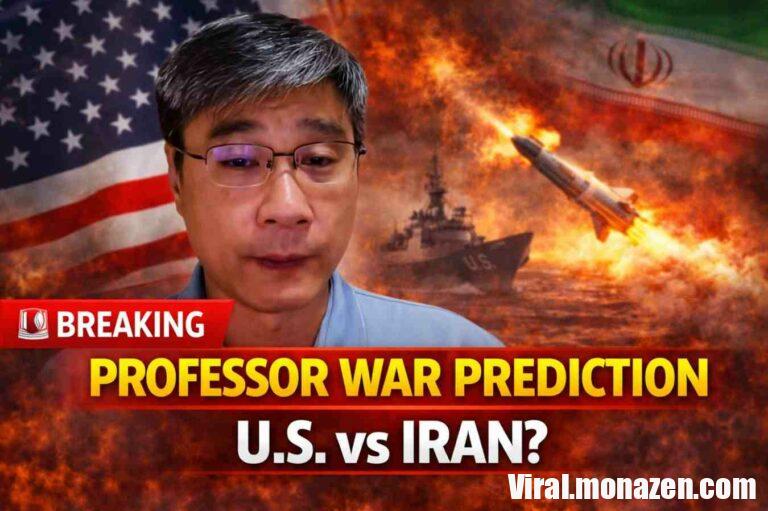
In the world of geopolitical forecasting, bold predictions often attract attention, but only a few generate the kind of debate currently surrounding Professor Jiang Xin, a Chinese scholar specializing in what he calls “predictive historical analysis.” With more than 1.5 million followers on his YouTube channel, Jiang has become a widely discussed figure in online political circles after claiming that three major geopolitical developments would unfold within a short timeframe.
According to Jiang, his predictions at the beginning of 2024 were straightforward but dramatic. First, he forecast that Donald Trump would win the U.S. presidential election. Second, he suggested that the United States would eventually become directly involved in a military confrontation with Iran. And third, he predicted that such a conflict could ultimately result in a strategic defeat for the United States, potentially triggering a profound shift in the global balance of power.
The first two predictions, at least according to Jiang’s supporters, appear to have materialized in some form. That has now placed intense focus on the third—and most controversial—forecast: the possibility that a prolonged conflict with Iran could lead to an outcome that fundamentally alters the international order.
During a recent televised interview, Jiang was invited to discuss this final prediction in detail. The conversation, lasting roughly fifteen minutes, explored his reasoning and the strategic factors he believes could influence the trajectory of a U.S.–Iran confrontation.
Strategic Depth and Long Preparation
One of Jiang’s central arguments is that Iran has spent decades preparing for a scenario involving direct confrontation with the United States or its regional allies.
Rather than focusing on conventional military parity, Iran has developed what many analysts describe as an asymmetric warfare doctrine—a strategy designed to exploit weaknesses in stronger military powers by targeting economic systems, logistics networks, and political stability.
According to Jiang, the most recent period of heightened tension—sometimes described in media commentary as a short but intense confrontation—offered Iranian strategists an opportunity to analyze the capabilities and response patterns of American and Israeli forces.
“In modern warfare,” Jiang suggested during the interview, “information gathered from even a limited confrontation can be extremely valuable.”
He argued that such encounters allow military planners to refine targeting strategies, assess air-defense responses, and study the operational tempo of their adversaries.
Targeting Infrastructure Rather Than Armies
Another key point raised by Jiang concerns what he views as a potential shift in strategic thinking.
Instead of focusing primarily on direct battlefield engagements, he believes Iran could prioritize critical infrastructure across the broader Gulf region.
Energy facilities, desalination plants, shipping lanes, and other economic lifelines form the backbone of Gulf economies. Disruptions to these systems could produce cascading effects across global energy markets and financial networks.
Water infrastructure in particular was highlighted during the discussion. Many cities across the Gulf rely heavily on desalination facilities for their freshwater supply. Damage to these systems—even temporarily—could create severe logistical challenges for urban populations.
While Jiang did not claim that such scenarios were inevitable, he suggested that infrastructure vulnerability has become an increasingly important factor in modern strategic planning.
Economic Interdependence and Global Markets
Jiang also emphasized what he sees as the broader economic implications of any prolonged regional conflict.
The Gulf region remains one of the world’s most critical energy corridors. Oil shipments through the Strait of Hormuz and other maritime routes are deeply intertwined with global markets.
According to Jiang, prolonged disruption in this region could have ripple effects far beyond the Middle East. Energy prices, investment flows, and financial markets could all react sharply to sustained instability.
He also raised a controversial point regarding the relationship between Gulf investment and emerging technology sectors in the United States. Some analysts have noted that sovereign wealth funds from Gulf countries play a role in financing major technology projects, including artificial intelligence ventures.
If geopolitical instability were to weaken these financial flows, Jiang argued, it could introduce new uncertainty into sectors that have driven much of the recent optimism in global markets.
The Cost Imbalance in Modern Warfare
Another argument presented by Jiang centers on the economic asymmetry of modern weapons systems.
He noted that advanced missile-defense systems—such as those deployed by the United States and its allies—can cost millions of dollars per interceptor missile. Meanwhile, relatively inexpensive drones or short-range weapons may cost only tens of thousands of dollars.
This imbalance, Jiang argued, could create strategic challenges if conflicts evolve into prolonged exchanges involving large numbers of low-cost aerial threats.
Military analysts have debated this issue extensively in recent years. Some argue that defensive systems remain essential despite the cost difference, while others believe that new technologies—including directed energy weapons and advanced electronic warfare—may eventually help address this imbalance.
Could Ground Forces Become Necessary?
During the interview, Jiang was also asked whether air power alone could achieve decisive strategic objectives in a conflict with Iran.
His answer was cautious but clear: historically, air campaigns rarely produce regime change without complementary ground operations.
“If the strategic objective becomes political transformation,” he explained, “air power alone has limitations.”
He suggested that prolonged pressure on regional infrastructure and military installations could eventually push allied states in the region to request stronger American intervention, including potential deployment of ground forces.
Such a scenario would represent a significant escalation, one that many policymakers in Washington have repeatedly sought to avoid since the large-scale ground conflicts of the early 2000s.
Why Would the United States Enter Such a Conflict?
Perhaps the most controversial portion of the interview came when Jiang was asked why the United States might become involved in a conflict that could carry such risks.
He outlined three possible explanations, each rooted in historical or political dynamics.
The first was what he described as “imperial hubris.” Throughout history, Jiang noted, dominant powers sometimes become overly confident after a series of successful interventions or military operations. This confidence can lead to underestimating the complexity of new conflicts.
The second explanation involved domestic political dynamics. Wars, historically, have sometimes been influenced by internal political calculations, alliances, and economic interests.
Finally, Jiang referenced a more speculative factor involving ideological or religious narratives about the Middle East and its role in historical or prophetic traditions. While he acknowledged that such ideas remain controversial and difficult to verify, he suggested they sometimes appear in geopolitical discourse.
A Prediction That Sparks Debate
It is important to note that Jiang’s predictions are far from universally accepted. Many experts strongly dispute his conclusions and argue that the balance of military and economic power still heavily favors the United States and its allies.
Others caution that forecasting geopolitical outcomes is notoriously difficult. International conflicts often unfold in unpredictable ways, shaped by diplomacy, economic pressures, technological developments, and domestic politics.
Nevertheless, Jiang’s interview has attracted significant attention online, partly because two of his earlier predictions appear—at least to his followers—to have aligned with real-world developments.
That has inevitably led many viewers to wonder whether his third prediction might also carry some degree of insight.
A World Watching Carefully
Regardless of whether Jiang’s forecast ultimately proves accurate, the broader question he raises remains important: how would a major conflict in the Middle East reshape global politics?
The answer would likely involve far more than military outcomes alone. Energy markets, financial systems, political alliances, and technological competition could all be affected.
For now, the interview has ignited debate among analysts, policymakers, and viewers alike.
And as tensions in the region continue to evolve, the world will be watching closely—both to understand what comes next and to see whether Professor Jiang’s controversial prediction remains merely speculation or something more consequential.