
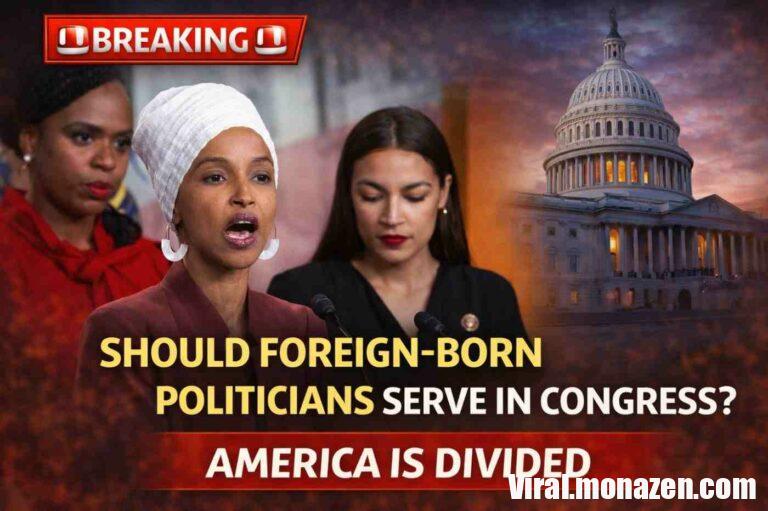
In recent years, a question has circulated widely across social media and political discussions: Should foreign-born individuals serve in the United States Congress, or should those positions be limited only to native-born Americans?
The topic often surfaces in heated online debates and viral posts, reflecting broader political tensions over immigration, national identity, and democratic representation in the United States.
While the question may appear simple at first glance, the issue touches on deep constitutional principles, the history of American immigration, and the evolving nature of political representation in one of the world’s most diverse societies.
Understanding the debate requires looking beyond slogans and examining what the law actually says, how the United States has historically approached citizenship and public office, and why this issue continues to resonate with voters across the political spectrum.
What the U.S. Constitution Actually Requires
The U.S. Constitution sets clear qualifications for members of Congress.
For the House of Representatives, a candidate must:
- Be at least 25 years old
- Have been a U.S. citizen for at least seven years
- Live in the state they represent
For the Senate, the requirements are slightly stricter:
- Be at least 30 years old
- Have been a U.S. citizen for at least nine years
- Reside in the state they represent
Notably, the Constitution does not require members of Congress to be native-born citizens.
The “natural-born citizen” requirement applies only to the presidency, a distinction that reflects concerns held by some of the nation’s founders about foreign influence in the executive branch.
For legislative positions, however, the framers chose a different approach—allowing naturalized citizens to serve once they had spent a certain number of years as Americans.
This decision reflected the country’s early identity as a nation built largely by immigrants.
America’s Immigrant Roots
From its earliest days, the United States has been shaped by waves of immigration.
Many of the country’s founding figures themselves were immigrants or the children of immigrants.
Alexander Hamilton, one of the authors of the Federalist Papers and the nation’s first Treasury Secretary, was born in the Caribbean before becoming one of the most influential figures in early American politics.
Throughout U.S. history, immigrants have played major roles in politics, business, science, and culture.
As the country expanded and its population diversified, naturalized citizens increasingly sought political representation to ensure that government reflected the realities of American society.
Allowing naturalized citizens to run for Congress became one way to ensure that immigrants could participate fully in the democratic system.
The Rise of Foreign-Born Members of Congress
Although relatively rare historically, foreign-born members of Congress have appeared periodically throughout American history.
In recent decades, several naturalized citizens have been elected to the House of Representatives, reflecting changing demographics and broader political participation among immigrant communities.
Some of the most widely recognized foreign-born members of Congress today include lawmakers who immigrated to the United States as children or young adults and later became citizens before entering politics.
Their presence in Congress often symbolizes the promise of the American Dream—the idea that individuals can arrive from anywhere in the world and eventually participate fully in the nation’s civic life.
Supporters see this as a powerful example of the inclusiveness of American democracy.
Arguments From Supporters of the Current System
Those who support allowing foreign-born citizens to serve in Congress often point to several key principles.
First, they argue that citizenship—not birthplace—should determine eligibility for public office.
Once an individual becomes a naturalized citizen, they take the same oath of allegiance to the United States as any other citizen.
From this perspective, excluding naturalized citizens from congressional service would create a second class of citizenship.
Second, supporters argue that diverse life experiences can strengthen democratic institutions.
Lawmakers with immigrant backgrounds may bring different perspectives to policy debates, particularly on issues such as immigration reform, foreign policy, and international trade.
Finally, proponents note that the United States has long defined itself as a nation of immigrants.
Allowing naturalized citizens to hold public office reflects that tradition.
Concerns Raised by Critics
Critics of foreign-born representation in Congress often frame their concerns around questions of national loyalty, cultural identity, or the role of immigration in American society.
Some argue that leaders who were born in the United States may have a deeper connection to American traditions and institutions.
Others believe that limiting congressional eligibility to native-born citizens would strengthen national cohesion and ensure that lawmakers share a common cultural background.
These views often emerge alongside broader debates about immigration policy, border security, and national identity.
However, legal scholars frequently point out that such restrictions would require a constitutional amendment—a process that historically has been extremely difficult to achieve.
The Constitutional Hurdle
Changing the qualifications for Congress would require amending the U.S. Constitution.
The amendment process involves multiple steps:
- Approval by two-thirds of both the House and Senate
- Ratification by three-quarters of the states
Because the process requires such broad consensus, constitutional amendments tend to occur only when there is overwhelming national agreement.
Historically, amendments have addressed issues such as voting rights, presidential term limits, and the abolition of slavery.
Proposals related to citizenship requirements for Congress have rarely gained significant traction.
A Reflection of Larger Political Divides
The debate over foreign-born members of Congress often reflects deeper divisions within American politics.
For some voters, the issue connects to broader concerns about globalization, immigration, and cultural change.
For others, it raises questions about equality, democratic participation, and the rights of naturalized citizens.
These competing perspectives illustrate how political identity and national identity are closely intertwined in modern political debates.
Representation in a Changing America
The United States is one of the most ethnically and culturally diverse countries in the world.
According to demographic data, millions of Americans today are naturalized citizens who came to the country from every region of the globe.
As immigrant communities grow, political representation has increasingly reflected that diversity.
Some analysts argue that this trend is a natural development in a democratic society where voters elect representatives who share their experiences and perspectives.
Others believe that questions about identity and national cohesion will continue to shape future political debates.
The Continuing Conversation
Ultimately, the question of who should serve in Congress is not only a legal matter—it is also a reflection of how Americans define citizenship, identity, and democracy.
For more than two centuries, the U.S. Constitution has allowed naturalized citizens to serve in the legislative branch, reinforcing the principle that allegiance to the country—not place of birth—defines membership in the American political community.
As political discussions evolve, the debate over foreign-born representation is likely to continue.
What remains certain is that the conversation touches on some of the most fundamental questions in American democracy: Who gets to represent the people, and what does it mean to be American?