
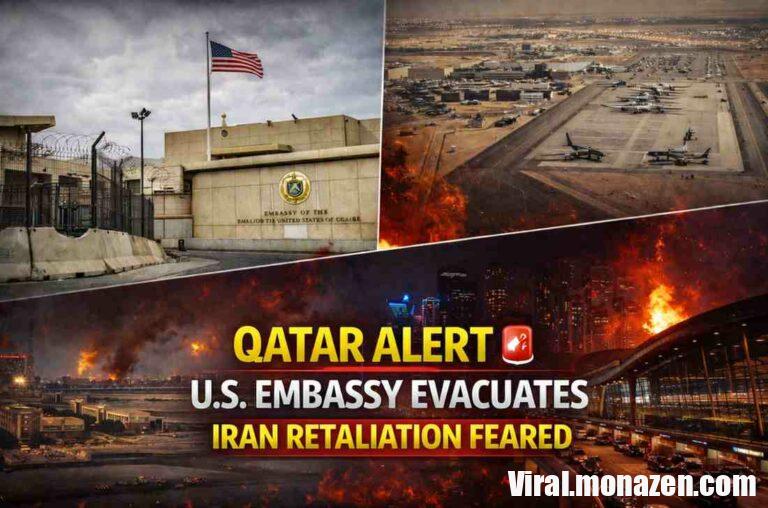
In the world of international diplomacy, evacuation orders are among the clearest signals that governments believe a situation may become dangerous. Such decisions are rarely made lightly, as they involve major logistical planning, sensitive security considerations, and the potential disruption of diplomatic operations.
Recent reports suggesting that the United States has begun reducing non-essential personnel near its diplomatic facilities in Qatar have therefore attracted significant attention across the Middle East and beyond. Although official statements have emphasized precaution rather than immediate crisis, the move highlights growing concerns about security risks in a region already under strain from geopolitical tensions.
At the center of the debate is a simple but critical question: why would Washington choose this moment to order evacuations in one of its closest regional partner countries?
A Rare Step in a Key Allied Nation
Qatar has long been considered one of Washington’s most important strategic partners in the Gulf. The country hosts Al Udeid Air Base, the largest U.S. military installation in the Middle East and a crucial hub for regional operations.
From this base, American forces coordinate activities ranging from counter-terrorism missions to intelligence surveillance and logistical support across several theaters.
Because of its strategic role, Qatar has generally been viewed as one of the most secure locations for U.S. personnel in the region. The country maintains close defense cooperation with Washington and has invested heavily in security infrastructure.
That context makes any reduction of diplomatic staff particularly noteworthy.
Diplomatic evacuations typically occur only when authorities believe that the risk environment may change quickly or unpredictably.
Understanding “Authorized Departure”
When governments order the departure of embassy staff, the decision often falls into two categories: authorized departure or ordered departure.
Authorized departure allows non-essential personnel and family members to leave voluntarily while maintaining core embassy operations. Ordered departure, by contrast, requires designated staff to leave immediately.
Reports about personnel reductions near U.S. diplomatic facilities in Qatar appear to fall closer to the precautionary category, rather than a full shutdown of operations.
Embassies sometimes adopt such measures during periods of regional instability to ensure that personnel can relocate quickly if conditions worsen.
These actions are not necessarily confirmation of an imminent attack. Instead, they are part of broader contingency planning.
Why Qatar Matters Strategically
Qatar occupies a unique position in Middle Eastern diplomacy. The small Gulf state has often acted as a mediator in regional conflicts, maintaining working relationships with a wide range of actors.
In recent decades, Doha has hosted negotiations involving groups and governments that might not otherwise meet at the same table.
At the same time, Qatar’s military partnership with the United States has grown steadily. The presence of American forces at Al Udeid Air Base underscores the depth of this cooperation.
Because of that dual role — mediator and strategic partner — Qatar has often served as a bridge between competing regional powers.
However, that position can also expose the country to geopolitical pressures when tensions rise.
The Broader Regional Context
The latest security concerns cannot be separated from the wider geopolitical environment in the Middle East.
Relations between the United States and Iran have remained tense for years, shaped by disputes over nuclear policy, regional influence, and military activity.
Episodes of escalation have included missile launches, drone attacks, cyber operations, and maritime confrontations in nearby waters.
While diplomatic channels sometimes reopen during periods of negotiation, the underlying rivalry has proven persistent.
When tensions increase, U.S. officials often reassess the security posture of their diplomatic missions across the region.
Protecting Diplomatic Personnel
Embassies are not simply administrative offices; they are extensions of national sovereignty abroad.
Ensuring the safety of diplomats and staff is therefore one of the highest priorities for any government operating overseas.
Security planning typically includes detailed evacuation procedures, emergency communication systems, and coordination with host nations.
When threats appear to increase — whether from terrorism, military conflict, or political unrest — governments may temporarily reduce the number of personnel on site.
Such measures allow essential operations to continue while minimizing risk.
The Role of Regional Military Bases
One factor shaping security assessments in Qatar is the presence of major military facilities nearby.
Al Udeid Air Base plays a central role in U.S. operations across the Middle East. Its strategic value means that it often features prominently in discussions about regional security dynamics.
However, the presence of such facilities can also influence threat calculations during periods of confrontation.
Military analysts note that large bases may become symbolic targets in scenarios involving retaliation or signaling between rival states.
For this reason, security planning often considers how diplomatic facilities and military installations interact in a broader defense framework.
Travel Advisories and Citizen Safety
When tensions rise, governments frequently update travel advisories for their citizens abroad.
These notices provide guidance on safety precautions, evacuation routes, and emergency contacts.
In some cases, citizens are encouraged to reconsider travel plans or to remain aware of rapidly changing security conditions.
Such advisories do not necessarily indicate immediate danger. Instead, they reflect the evolving risk environment.
For expatriates and travelers, staying informed through official channels is often the most effective way to navigate uncertain situations.
Diplomatic Signals and Public Perception
Beyond their practical implications, evacuation measures can also carry symbolic weight.
Observers sometimes interpret such decisions as signals about how seriously governments view potential threats.
Even precautionary actions can influence public perception, especially when combined with headlines about regional tensions.
This dynamic can create a feedback loop in which security measures themselves become part of the broader narrative surrounding geopolitical risk.
For diplomats and policymakers, managing that perception is often as challenging as managing the underlying security situation.
Qatar’s Response
Qatar has historically emphasized its commitment to protecting foreign diplomatic missions within its borders.
The country maintains close coordination with international partners on security issues and regularly conducts joint exercises and intelligence sharing.
Officials in Doha have repeatedly underscored that maintaining stability and protecting diplomatic personnel remain top priorities.
Such assurances are standard in situations where embassies adjust staffing levels due to regional concerns.
Host governments typically work closely with foreign missions to ensure that security arrangements remain effective.
A Region Watching Closely
Across the Middle East, every diplomatic move is closely scrutinized by governments, analysts, and citizens alike.
The decision by the United States to reduce certain personnel near its diplomatic facilities in Qatar is therefore being interpreted through multiple lenses.
Some view it as a routine precaution in a volatile region. Others see it as a sign that Washington is preparing for potential escalation.
In reality, both interpretations may contain elements of truth.
Security planning in complex geopolitical environments often involves preparing for scenarios that may never occur.
The Importance of Communication
During moments of uncertainty, clear communication from governments and international organizations becomes especially important.
Official statements, travel advisories, and diplomatic briefings help ensure that citizens and partners understand the rationale behind security measures.
Without such communication, speculation can quickly fill the information gap.
Maintaining transparency — while protecting sensitive intelligence — is therefore a delicate but essential task.
Looking Ahead
For now, the situation in Qatar appears to remain stable, with diplomatic operations continuing despite precautionary adjustments.
Yet the developments serve as a reminder of how quickly regional dynamics can influence security planning.
In the interconnected landscape of Middle Eastern politics, events in one area often ripple across borders.
Diplomatic evacuations, travel advisories, and military alerts are all part of the toolkit governments use to navigate that uncertainty.
As tensions evolve, policymakers will continue to weigh the balance between caution and engagement — seeking to protect their citizens while preserving the diplomatic relationships that help maintain regional stability.
And in a region where history has shown that small developments can carry large consequences, even precautionary steps can attract global attention.