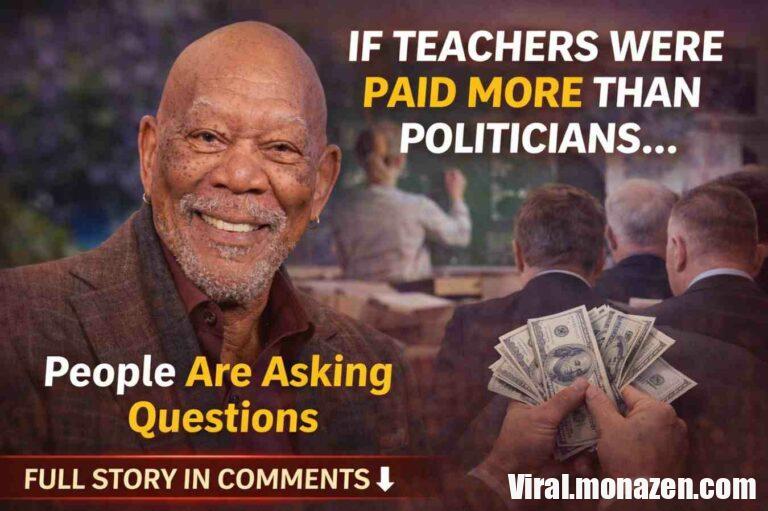
In the age of social media, a single sentence can ignite a worldwide conversation. One quote currently circulating widely online has done exactly that.
The statement, often attributed to actor Morgan Freeman, reads:
“Maybe if we underpaid politicians and overpaid teachers, there would be smarter people and less stupid laws.”
Whether or not Freeman ever actually said those words remains unclear. What is certain, however, is that the idea behind the quote has resonated with millions of people across social media platforms.
Within days of the image spreading online, thousands of users began debating the message behind it — raising questions about the value societies place on education, leadership, and public service.
At its core, the viral quote taps into a deeper issue that has been discussed for decades: Should teachers be paid more than politicians?
And perhaps more importantly, what would happen if they were?
Why the Quote Resonates With So Many People
Education plays a foundational role in every society.
Teachers influence the development of future scientists, doctors, engineers, entrepreneurs, and political leaders. Yet in many countries, educators say their salaries and working conditions do not reflect the importance of their work.
The viral quote captures a frustration that many parents and educators feel: the belief that teachers — who help shape future generations — often receive less recognition and compensation than professions that rely on the skills those teachers helped build.
For many readers online, the quote is less about literal policy proposals and more about highlighting a perceived imbalance in societal priorities.
The Reality of Teacher Salaries
In the United States, teacher pay varies widely depending on state, district, and years of experience.
According to education data, the average public school teacher salary in the U.S. is roughly between $60,000 and $70,000 per year, though many teachers start far lower early in their careers.
In some regions, educators report needing second jobs to cover living expenses.
Meanwhile, teachers also face growing responsibilities, including:
- Managing larger classroom sizes
- Navigating changing educational standards
- Addressing students’ social and emotional needs
- Integrating technology into learning environments
Education advocates argue that increasing teacher salaries could attract more highly qualified candidates into the profession and help reduce teacher shortages that many school systems currently face.
How Politician Salaries Compare
By contrast, members of Congress earn $174,000 per year, while top leadership positions earn even more.
Presidents, governors, and senior officials often receive higher salaries along with benefits, security, and retirement packages.
Supporters of competitive salaries for politicians argue that paying public officials well can help reduce corruption and attract experienced professionals to public service.
The reasoning is that individuals responsible for governing large nations or states should be compensated appropriately for the complexity and responsibility of their work.
However, critics often argue that political salaries can appear disconnected from the economic realities faced by average citizens.
This perception fuels the emotional response many people have to viral quotes like the one circulating online.
Countries That Invest Heavily in Teachers
Interestingly, some countries that consistently rank near the top of global education rankings also invest heavily in teachers.
Finland is often cited as an example.
In Finland:
- Teaching is one of the most respected professions.
- Teachers undergo rigorous university training.
- Salaries are competitive with other professional careers.
The result has been one of the most consistently high-performing education systems in the world.
Singapore and South Korea have also built strong education systems partly by elevating the status and compensation of teachers.
Education experts often point to these models when discussing long-term education reform.
The Link Between Education and Governance
The viral quote also suggests a broader relationship between education and political leadership.
Many analysts argue that stronger education systems contribute to more informed voters and stronger democratic institutions.
Well-educated populations tend to show higher civic engagement, increased participation in elections, and stronger understanding of public policy issues.
In this sense, investing in education may indirectly improve the quality of political leadership over time.
Better education systems help produce leaders who are better prepared to address complex social and economic challenges.
Social Media’s Role in Amplifying the Message
The internet has dramatically changed how political and social ideas spread.
In the past, a quote like this might have appeared in a speech, a newspaper column, or a book.
Today, a single graphic shared on social media can reach millions of people in hours.
Images that combine a recognizable celebrity face with a bold message often travel especially quickly across platforms like Facebook, X (formerly Twitter), and Instagram.
Even when the quote’s origin is uncertain, the message itself can resonate strongly enough to fuel widespread debate.
The Misattribution Problem
The quote circulating online is commonly credited to Morgan Freeman, but there is little evidence confirming he actually said it.
Misattributed quotes are extremely common online.
Celebrities such as Freeman, Albert Einstein, and Mark Twain are frequently credited with statements they never made because their names lend credibility and familiarity to viral messages.
Despite the uncertainty about the quote’s origin, the discussion it has generated continues to grow.
For many people, the identity of the speaker matters less than the underlying message.
A Larger Conversation About Priorities
Ultimately, the viral quote reflects a broader societal conversation.
How much should societies invest in education?
How should governments balance compensation across professions that serve the public?
And what role does education play in shaping the future of political leadership?
There are no easy answers.
But the intense response to the quote demonstrates how deeply people care about the role teachers play in shaping society.
The Bottom Line
Whether the quote actually came from Morgan Freeman or not, its message has clearly struck a chord.
Millions of people around the world are now discussing the same question:
What would happen if societies valued teachers as much as they value political power?
For some, the answer seems obvious — stronger schools, better educated citizens, and perhaps even more effective leadership.
For others, the issue is more complicated, involving budget constraints, policy priorities, and the many challenges facing modern education systems.
What’s certain is that a single sentence shared online has managed to reignite one of the most important debates of our time: the value we place on education and those who dedicate their lives to teaching the next generation.